Wednesday, 20 February 2008

Environmental Log 1 - A few environmental issues in North Africa

For the first month of our trip we have been traveling quickly to reach the 'real' Africa popular consensus agrees, is south of Egypt. One of the purposes of our trip is to investigate the social and environmental issues that we come across and although we are just beginning to investigate a few areas in depth, future Environmental Logs will focus more upon specific issues and/or projects we visit on our way down the continent. As we have been traveling we have seen two general environmental issues clearly lain before us: waste and water.

Waste
Everywhere we have traveled throughout the North of Africa, rubbish has been strewn throughout the streets, river banks, roads, roadsides and anywhere the wind so chooses to place it. Obviously, the root cause of this is the lack of proper waste disposal system. However, it has surprised us the lack of concern the general population show for the issue. The attitude of the general populous clearly led the Sudanese teachers we met in the Northern Village of Kerma some despair: the rubbish was providing an environment for a glaucoma causing fly. In previous travels and living in Guyana we found that in the absence of a proper disposal system people generally devise a system to prevent their village / town from stinking, be it something as simple as putting the rubbish in one place, often in a pit essentially creating their own landfill / incinerator. For some reason this mentality simply does not exist in the places we have been through.

Water
The most prevalent and pressing issue we have encountered on our travels has undoubtedly been water. In Libya the construction of the Great Man Made River demonstrates a country under severe water stress. The long term environmental impact of this is unclear but unlikely to be without consequences. Necessitating a 2000km pipe, 4m in diameter to pump into a reservoir with a capacity of 6.8 million cubic metres smacks of a country with a drink problem that needs to be addressed to achieve a sustainable balance.

The Ankh we saw adorning the wall of pharaoh's tomb was the symbol of life for the Ancient Egyptians, it is in fact a representation of the Nile and its delta. This is still the case in modern day Egypt, the country is utterly dependent upon it as a provider food and electricity. If one is to look at Egypt from above, it is clear that there is not much else other than desert over the rest of the country. As we travel we will be reaching the sources of both the Blue and White Nile as far south as Uganda and we currently sit at the confluence of these rivers in Khartoum. The number of countries that the river runs through makes Egypt precariously dependant on the agreements that are in place over the management of the river. At present the agreements appear strong but if water demand begins to dramatically out way supply it is hard to imagine this becoming a source of friction in the region.

The building of Aswan high dam in 1973 was Egypt’s attempt to master the Nile, a sign describing the wonders of the dam, strategically placed at the tourist friendly viewing point, proudly proclaimed, 'The High Dam project is considered the Egyptian challenge against the silent nature.' The social impact of the dam was dramatic: hundreds of hugely significant monuments and historic sights were only saved from submerging by a unprecedented international rescue effort (including Abu Simbel temple below). The dam also internally displaced 40,000 people who the Sudanese government forcefully relocated to the present day Wadi Halfa, where the ferry from Egypt docks. The dam now blocks vital sediment from traveling down river. This has lead to the erosion of farmland at the Nile Delta. Unquestionably the dam has made Egypt more productive at the present but if there is more erosion as a result of a reduction in volume of sediment being transported, then this productivity will be short lived. The cheap electricity the dam and the old dam provide is central to the functioning of the country but, once again, the dam appears to be a relatively short term solution to a long term environmental issue.

Short term needs against long term sustainability
A key question that arises again and again is, how do you balance the short term needs of the people against the needs of future generations to be able to continue to use the land and be productive? We cannot claim to have answers and in our brief time traveling we cannot claim to know if these issues are being addressed, we would be interested to hear if anyone reading this has greater knowledge. Short term thinking in the developed world is driven by profit or election cycles but in the developing world it is driven also by survival. This was something made patently clear when we walked through the slums of Cairo. An obvious and legitimate culprit for a major stress on the environment is the human population. Once we find the human population guilty, it is very hard to see how population can be part of any solution.

Environmental awareness
It’s hard to judge the level of environmental awareness in countries where you don't speak the language or spend much time. However it is clearly in the public consciousness, in Egypt we did speak to a number of people with an awareness of and concern for environmental issues. In the weekly Al Ahram English newspaper there was a big article about climate change focusing on the effects on Cairo. Particularly it commented on the increased rainfall over the past few years which the drainage system has not been able to cope with, something we paid testament to with sodden feet. In Sudan we have also encountered anecdotal evidence from farmers that in recent years it rains a lot less in the North and more in the South. In the North at least this has not had any effect yet as the crops grown are entirely dependent on irrigation using diesel pumps to draw water from the Nile. It has also been said that the conflict in Darfur was in part caused by climate change and China’s interest in the area are both issues we shall return to in a later log.

In both Sudan and Egypt we have noticed an under utilization of naturally available renewable sources of energy, in particular solar hot water. This was a cost effective and common sense solution to a everyday problem we saw in Tunisia but not elsewhere. The areas we have traveled through are obvious candidates for solar panels, which we have seen used minimally, attached to telecommunication masts. It is an encouraging sign that the Sudanese five pound note carries images of wind turbines and solar panels. How much this is talking the talk as opposed to walking the walk we do not yet know. What is not in doubt is that there are powerful resources available which need to be utilised.

Saturday, 16 February 2008

Travel Log 6 - Aswan to Sudan, Wadi Halfa, Abri, Kerma and Dongola

04/02/08
We woke early and caught the rickety train with its doors wedged open and all of its fabric, ceiling mounted handles severed, as if it had traveled as slowly as it was taking us from Aswan to the High Dam, all the way from some distant metropolis.
We were fast tracked through the passport control to leave Egypt, joined by a different breed of tortoise (traveler / backpacker), two Peruvians (smartly dressed and seeming out of place), two Japanese, two Spaniards and one German (The last three nationalities of which we would travel with on and off till at least Khartoum). Later we also met the three Russian cyclists we had met at the Sudanese Embassy.

We were scheduled to leave at 12.00 and instructed by the man who sold us the tickets to be at the ferry at 10.00 to get seats. We eventually set off at 21.00 on our seventeen hour ride to Sudan. We successfully vied for a bench each to sleep on and took it in shifts to guard as we the other took the opportunity to get some air. The wait for departure was a wait without air. With the boat stationary and the low-ceilinged seating area rammed with people, many of whom were smoking the air was clammy and toxic.

There was an uplifting atmosphere where we sat. A powerful lady led a group of passengers in a song which she MCed over with high-pitched, rapid 'lalalalalala's. The whole thing kept together with ingenious clapping rhythms, skipping on and off the beat. There was a colorful array of passengers – a brightly dressed woman with henna covered feet (meaning she was recently married), there was a man in a huge head scarf and an ill fitting Mafioso blazer, staring toddlers all vied for space. The space on the luggage racks was at a premium, as it meant the passenger would not have to wait for their luggage to leave the cramped hold, it was therefore the source of a great deal of heated arguments, placated and in some cases compeered by a tiny waif of a man. His job was to shout louder than anyone else, strutting around the boat with veins bulging from the side of his delicate head.

When we got moving some cool air came from Lake Nasser came through the portholes but it was not enough to prevent it from feeling like a steaming, mildewed flannel on the face.
Above deck was an encampment floored with individuals blankets, surrounded by boxed held together with string, the lucky ones in the shade below the lifeboats. To get hold of our in-flight meals we handed in a ticket we had previously exchanged for a different ticket – presumably to keep a ferry official's relative in work.


Upon returning to our bench from the café on the mid-deck (a million miles from the Marseilles – Tunis ferry café) a man who had earlier positioned himself at the end of the bench and had been sleeping on it while we were away, insisted on positioning himself on the floor.


It is likely that actions of this man and a holy man in the café who bought us tea are more to do with the way of life of the passengers of the boat – being mainly vendors of wares for natives of their country as opposed to tourists but we felt a warm glow at the possibility that we were traveling to a place where people had a different mindset to that which we knew. This transition mindset was something we were privileged enough to feel change with the landscape, gradually.


05/02/08
We caught a lift in the back of a pickup from the Sudanese passport control to Wadi Halfa and after almost a month of travel, we found ourselves in what we had expected to find when we came to Africa.
We left our bags in the mud brick hotel and went in search of food. A boy stood outside a darkened room with newspaper piled high with fried fish, seemed indifferent to our decision to come to his restaurant. Inside, there was a welcoming silence presided over by three men in immaculately white robes who responded to our salaams (hellos) with undue reverence.


06/02/08
From 8.30 till 12.00 we moved from room to room with in the police station in order to fulfil the required registration process.
Our paths crossed those of the other tortoises, occasionally overtaking one another and keeping each other up-dated on how many officials we had seen.

The day before we had written our names in the book of a bus driver who said he would take us to the next significant village, eight hours away Abri for SP15 (about £3.20) but we had found a Bedford truck driver who would let us sit on his bags of cement for SP5 which would be far less stuffy. As we set off with some of the other tortoises four hours late (roughly on time, African time) the bus we had put our names down for pulled up in front of lorry. A great deal of shouting and shoving ensued and the bus driver offered us a ride in his heaving carriage for SP5 which we declined and he got in quite a huff.


At the back of the lorry was a white robed man with a strange arrangement of material on his head. He remained cross-legged in a Zen –like state of peace, seemingly motionless and unblinking in the clouds of dust. Periodically we stopped to refill the radiator and our bellies. It was good to enjoy the rough ride provided by the road which will soon be paved as Sudan is currently doing rapidly with all its major roads. The landscape was harsh desert but yet there was an alluring appeal to it, perhaps more of a sense of adventure.

As dusk rose from the horizon like ink on blotting paper, we were able to watch the stars fade into the blue sky to accompany the sliver of moon. When darkness fell the desert sky was so full of stars it looked deep as if it were the sea and we were fish held above its surface.

In the dead of night we passed what looked like a staged crime scene. Three people stood solemly watching the back of the head of a man on the ground, lit by the lights of their stationary truck in the middle of nowhere. One of our passengers mimed that they were praying

We spent the night in Abri's only lokanda (a very basic hostel) and ate the only thing on the restaurants menu, fu'ul (beans mashed with the bottom of a glass Pepsi bottle with oil and chopped onions and tomatoes with bread. We spent the night talking to a man from Darfur who eulogized about Sudan.


07/02/08
Our day spent unsuccessfully looking for a lift to Kerma by boksi (Toyota pickup with improvised roof rack and benches) lorry or bus turned out to be a good way of meeting the people of the village which had been built upon its market of ten or so stalls and people stopping on their way to Dongola and then to Khartoum.


We were sent from person to person about the town, fuelled by the tea they gave us. We were given high fives by the police who talked to us about the Queen Mother. A female teacher in the school instructed her prize pupil to speak English to us. We were told that we would be able to leave on Sunday at the earliest (two days time) so we prepared ourselves for another night in the mud brick hotel. Showering from a bucket in a silver basin used for mashing fu'ul, in the stinking toilet.

We spent the evening watching the semi-finals of the African Cup with most of the village, who all paid the equivalent of two cups of tea for the privilege and were boisterous company. It was strange to see the reverence with which they watched the premium adverts which were offering Saudi golfing and bespoke bathrooms and brought to mind the question of how these people perceive the world base upon the information received by State Radio, BBC Arabic service and satellite TV for Arabia.

Spectators with and without English were keen to speak to us. The police captain, then wearing his garabea moved the tobacco wad behind his bottom lip slowly smiling at us like Little John. He stood by us dumbly as if his very presence spoke for its self, shifting the weight on his feet several times then mooching off with the same grin fixed across his face.

That evening we were treated to an unexpected appearance of local hero on television – Muhammed Wordi. An eighty year old Nubian crooner sat upon a wooden throne with an extensive backing group sat in front of 1970's Top of the Pops backdrop, singing to the Sudanese glitterati who were sat upon plastic garden furniture. He had an impressive voice and sang in Nubian and Arabic.


08/2/08
We were woken by an irritating runt repeating ‘Now truck!’ We followed him outside, ‘When is the truck?’, ‘Eight’, ‘Its nine now’, ‘Yes’, ‘Where is it?’, ‘Here’, ‘Where?’.
At this point the farce was ended by a half Egyptian half Sudanese pizza chef from Berlin who translated for us via our German traveling companion, Johan, that the bus would come tomorrow.

A seemingly dead day was put to good use as there would not be transport on this day being Friday (the Muslim day of rest). We paid a man to take us down the Nile to look for crocodiles. The crocs nervousness was explained as he pointed towards them and mimed that they tasted delicious. As they came into view they shuffled awkwardly into the dark water. They seemed far from threatening despite their relatively large size (7ftish).


He dropped us by the river bank and upon mounting the river bank were encountered by a vast sandy wilderness, our guide pointed at the horizon enigmatically. Upon following his finger for a kilometre through the desert we came upon the ruins of a Nubian temple, its columns withered away by the sand but its mud brick roads still visible and no one as far as the eye could see.


Upon our return to the hotel a man with the drooping moustache and facial scars of a panto villain bundled us into a boksi and all of a sudden, we were on our way to Kerma, just as we had relaxed into the bokra (tomorrow or bokra bokra for the day after and so on) mentality. Johan took exception to the driver’s technique of generally off road, straight through the desert sand, very fast and stopping at most of the hamlets to embrace friends and family. At regular intervals he would say, ‘this man is so stupid! No? He is crazy!’, he repeated this like a mantra it is interesting to see different people coping mechanisms for quite a rough journey. The sugar coated peanuts were got in Cairo went down well with the children who came running to the back of the boksi when it stopped as we shook hands with the men authoritatively and the women tittered from behind their veils , chasing us down the road through he clouds of dust the children were filmic. The sight of women in jet black hijabs bordered in colors, iridescent like beetle backs gliding through the yellow of the desert was beautiful. We ate fu'ul and slept in a room with ten other snoring men.


09/02/08
The Spanish German extremely tight budget prevented then from seeing the Deffufa, a mud temple built three thousand years BC.
After a session of lackadaisical bargaining with the armed guar we were allowed clamber all over it. It was reminiscent of the twenty foot tall contemporary mud domes we had seen in the graveyards we had passed. Inside the thick towers hundreds of birds nested and shot out as we passed under. There did not seem to be an inside to it – it was all wall and crevice. Any explanation we may have received in the recently opened museum was denied as the guards could not find the key.

The Spanish and German tortoises headed for Dongola while we and Yuya (Japanese) decided to stay another night in order to see the market the next day. We found a café and sat by the Nile drinking guava juice. We watched as three people within ten metres of one another, one fished, the other bathed and the other threw in the waste from his restaurant. Our lunchtime mission to find something other than fu’ul was a success. We were invited in the kitchen of the restaurant and pointed out what we wanted – omelet, goat, fried fish, beans, rice and lettuce. Our stomachs were very pleased with us.

To walk it off, we headed out of town and came across a maze of brightly painted houses and alleys ruled by gangs of small children who darted from building to building, peering around corners. We were greeted on the road by a lanky man in a garreba (local dress, long flowing gown) and wrap-around sunglasses. He invited us to his relatively grand house and plied us with spiced tea, telling us about his farm and life. More men from the village turned up and tried their hand at speaking English. This continued until dusk, all the while, a stream of women passed in front of us, through our host’s garden. From our laid back chairs and with the conversation flowing sedately from the universal humor of mild sexism to matters of gravity we got a glimpse at what they got up to. Within the context of the history of conflict between the north and the south it was interesting to hear that it was invariably Southerners who were given the public whipping. As they did not have houses to stay in, they were seen on the streets drunk and punished.


We were offered a date alcohol but declined as no one else was drinking it. Maybe we were overcautious but the penalty for drinking in Sudan is forty lashes. Our host offered to take us his farm on an island in the Nile the following day. A teacher who had joined us suggested we visit the school he taught at – Sukdo Primary.


10/02/08
A man in Western dress and very proper English ushered us into the school. We were brought to the headmistress’ office and were given tea and toffee and introduced to all the school’s teachers.
It transpired that Said (the teacher from the previous day) taught in the boy’s school and we were in the girl’s. Said would arrive shortly, as was explained to us with all finger-tips of one hand touching and pointing upwards like a sleeping snake. Until he arrived we were taken from class to class to give our royal approval to the students. They were instructed to sing songs for us as we stood at the front of the class, after introducing ourselves. We clapped politely as and nodded approvingly, relishing the smiling awkwardness of it all.

Said arrived and took us to his school where lessons were postponed and we ate a delicious breakfast of grahna (pancake-like bread and mashed, spiced okra)with all of the schools teachers. Everyone was keen to emphasize that not all of Sudan was like what we had seen on TV, that was the west and we were in the north – a reasonable point in a country the size of Western Europe, Darfur alone the size of France. Several teachers walked with us to the riverbank to catch the boat to the island where we had arranged to visit the farm previously.


We sat below the date palms and ate what the teachers had knocked down with rocks. They explained they did not talk about politics in general as we probed as this would lead to a jail sentence. One of our company, wearing fetching mock leopard skin shoes, explained the scarring we had seen on many people’s faces. This practice was unusual in the north but still widespread in the south. All over Sudan people still used ritualistic burning for its medicinal qualities, which does not seem that dissimilar to acupuncture. A burn to the arm for stomach aliments, a burn to the back of the head for throat problems, two burns to the temple for eye problems. On dark skin these burns did not look as gruesome as they might on white, no more obtrusive than a tattoo.

We retuned to our hostel by donkey cart hoping to find transport to Dongola. We headed for the market while our boksi driver ate his lunch before departing. The market was a meeting for people all over the area who brought their fruit, vegetable, spices and cakes to sell to one another. The small stringed instruments some men from our room had been making at the hotel seemed to go down well, with people, perhaps a little too old, strutting about the place, playing them enthusiastically. There was a great deal of bawdy slapstick that could have been lifted from the Canterbury Tales, like the midget selling papers from the back of his cart was taunted by a group of teenagers and retaliated with his donkey whip.

To enter the town we took a ferry across the Nile where we met a man with a fancy Chinese motorbike and either an overactive imagination or an amazing tale. Perhaps, he had studied in California and Russia and received is PhD in New Dehli. Perhaps for a time he shared a house with a man who flew one of 9/11 planes. Perhaps, as a result of this he was kidnapped in Sri Lanka, almost shot and ended up spending three years in Guantánamo Bay, then the police took us into an office to take our passport details so we never got to hear the end of his articulate and well told story even if the reality of it is in doubt.

Three of us, luggage included, just about fitted into the tuk-tuk the police instructed us to get into. Upon arrival at the hotel we walked for half an hour to find the police station to register ourselves in the town. We spent the night watching Rigobert Song loose the Africa Cup for Cameroon in a gloomy club, where people smoked and watched TV as if they were in an opium den, on a TV balanced on a bottle crate.

11/02/08
Dongla was an unappealing place interested in the shifting of Chinese tat.
When we met our lokanda owner he would get us to repeat the Nubian ‘hello’, ‘Mescargis’ we had originally greeted him with, as it was a joke which did not grow old for him. We spent our time mooching from shade to shade drinking tea. We met a student of pharmaceuticals a lawyer who told us legally, we could drink alcohol in Sudan and a very short man with a huge gold-buttoned blazer who thoroughly confused us.

Sunday, 3 February 2008

Travel Log 5 - Cairo to Luxor and Aswan

28/01/09
The train ride from Cairo to Luxor was relatively comfy and mildly amusing.
Before boarding the train we thanked our lucky stars that we had asked someone to right the Arabic numbers down for us. The station was a mass of confusion. During the hour delay, as we fretted about whether we were going to be getting on the right train, we were able to watch some kind of ruckus involving wailing women and a surging crowd forming around one man. Men in various uniforms (navy, army, dog handler, police), tourism police nonchalantly crossed the train track and had a look. Upon arrival, the heavily armed guards at either end of the train gave a sense that were going to be entering Red Indian country. The carriage TVs were not working, and looked as if they had not, for quite some time. Our alternative entertainment was a group of young Muslim girls playing charades.

29/01/08 – 31/01/08
The boat from Aswan to Sudan would not leave until Monday so we saw the standard Luxor sites as part of a group; Valley of the Kings, Valley of the Queens and the Hatshepsut Temple.

After sixty tourists were shot ten years ago, one left with a note stuffed inside his eviscerated body reading 'no tourists' the crowds at the sites were a quarter of what they had been a few years before. Even so, they heaved with all nationalities. The sugar cane on the roads to these sites was cut back to make an area of no mans land, twenty metres in width, in order to discourage terrorists from attacking the buses. This seemed like a rather cosmetic solution.

The first tomb we entered was the most spectacular – that of Rameses II. Much of the colour was as fresh as that of Egyptian shop fronts a few years in age. It was the first occasion when the imaginary and garish Egypt of school books was in any way realised. The imagery and repetition of imagery was even more alien than that of the Islamic art.

A man with an elongated head (a hereditary condition and in some cases, induced with the use of a wooden press) was offered a symbolic feather by a god with a beetle for a head.

The anatomical accuracy of the horses and be-headed Nubian slaves far exceeded any of the Roman art we saw in Libya. However, we did pine for the empty ruins to saunter through.

The graffiti from antiquity had rendered many of the depicted faceless and the fertility god with one arm, one leg and a giant penis had been castrated. It seemed to be lacklustre defacement because everything above arm height was in tact.

We visited the temple of Hatshepsut or ­'hot chicken soup' as she is otherwise known by tour guides who took advanced humour in their tourism certificates. She ruled Egypt as the daughter of a god and her embalming temple of three stories which took eighteen years to build and was closed after the seventy days required to complete the embalming process.

Although these sites were busy and our guide seemed far more interested in selling us key rings than anything else, it was hard not to find the enormity of their vision and execution of it awe inspiring. Trying to imagine these places at there respective times of construction (a time period spanning several hundred years, yet with such an unnervingly consistent perception and depiction of the sublunary and preternatural) was like looking over the edge of precipice.

We hired clapped out bikes and negotiated the assault course of Luxor's roads to the temple of Karnak with its hall of a hundred and thirty four huge lotus or papyrus pillars (depending on your source). The way the afternoon light presented them and the hieroglyphs, statues and obelisks gave the place a forceful air made it partly unwelcoming, like a proud old man in his sick bed, who did not want visitors. This was compounded by tourists who did not treat the sites with a semblance of the tact usually associated with holy places, irrespective of religion.

Cycling along the Continental side of the Nile in the with hot sun and a cool breeze, lined with globe shaped street lighting and absurdly uniformed cruise ship workmen, allowed the cries of the felucca sailors (the felucca is a white, curve-masted, single sailed Egpytian boat), taxi drivers and the horse drawn carriage drivers float gently out of ear shot.


01/02/08 – 02/02/08
We went on the train from Luxor to Aswan, along a track following the Nile as in gently meandered through the landscape.
We were able to watch the architecture become more Nubian as we headed south.

We later visited the Nubian Museum to find out more about this intriguing and persecuted ethnic group that was almost decimated by the construction of the Aswan Dam. Its construction forced them to relocate and much of their homeland and culture was submerged by Lake Nasser. We saw thousands of years of their beautiful jewellery and painting and statues. There were descriptions of the incredible feats of engineering performed by international teams of engineers and scientists to preserve Nubian monuments, which in one case involved the winching of a temple to higher ground.
It would be nice to think that the Czech funding of the museum was inspired by an ancient Eastern European atonement – it was a group of marauding Bosnians who deposed one of the Nubian kings as part of the expansion of the Byzantine Empire. It was clear as well from the pictures of the Nubian people, that there faces are quite un-Arabian alluding to the next phase we waited for with baited breath as we prepared to travel further south.

Aswan was picturesque enough to warrant it banks to be rammed with cruise ships. As light flickered on the Nile excitedly like millions of silver fish leaping above the surface, with feluccas in the background and an old man fishing with a simple line from a boat in the foreground, it was all a little saccharine. It may have been cynical to think so, but surely the very same image from the perspective of someone in his position would be to think, that man has a hard life, I bet he wishes he had a trawler. Profiting from poverty via tourism seemed unsustainable, but with tourism as Egypt's primary source of income, something for the time being, unavoidable.

We managed to reduce the increasing annoyance of the curb-crawling, hooting taxis and felucca sailors and shop owners by treating their monotonous questions, 'hello my friend, where you from?', 'what you want?' and 'where you going?' as an opportunity to give more and more brazened answers.

Our top three Egyptian sales patters are as follows;
΄Bedouin coffee never end, you stop when you see the pink elephant΄
΄What you want?΄ ΄Nothing΄ ΄I have nothing!΄
΄How can I take your money?΄

During our visit Aswan was a hive of activity as the school children were in there winter holidays. It was interesting to see how the resort treated them differently to the non-Africans. It would be unfair to begrudge the Egyptians whatever money they can harvest from the tourist crop because it the same crop that sails around in cruise ships that are polluting the Nile. Having spent relatively little time in Egypt though and only at major tourist destinations it feels like we have not been able to see a genuine side to Egypt as we understandably are seen immediately as a source of cash and along with the language barrier which makes interesting debate and gaining a real insight pretty much impossible.


A Canadian man we met who visited the town thirty five years ago had seen it without the cruise ships and without its riverside promenade an extremely different vision, although, how different were most places thirty five years ago. When we took a boat to the west bank of the Nile it was just about possible to imagine what he had seen. After the initial nonsense of being told that the hill we wanted to climb closed at four and we were only permitted out of the village on camel back, we sneaked our way through the back of the village. The pace of life after a five minute boat ride was entirely different. There were children playing football under the date palms and old women huddled together, dressed head to toe in jet black chuckling away and finding the very sight of us hilarious, in a joyful and inclusive way. Of course the children chasing us through the streets asked us for money but when we declined, they did not take it as a personal affront, it was more of a game than a career. As the sun set we had birds eye view of both banks from our unauthorised hill, backing onto the endless desert, it was a chance to ponder which side of the Nile had it better, the one with the big road and the railway line or the one without.

Monday, 28 January 2008

Travel Log 4 - Marsa Mutrah to Cairo

21/01/08
Alexandria’s ancient layout was not well equipped for the hordes of ancient, garishly painted Lada taxis. We arrived in Alexandria en route to Cairo on the bus we took that morning.

The aged trams crept beneath the monstrous high rise housing and the sad, faded glory of the Colonial architecture. It was a sensory overload with most spivs, goldbricks and wheeler dealers having a strong enough command of the English to play their angle.

It was only when out on the sea front and with a bit of objectivity that we could really appreciate what a startling place it was – it looked as if it had and would be there for ever.

We only had a few hours to spend in Alexandria though before heading off to Cairo. Another four hours on the bus, this time sat next to a man relishing his own obesity with a melodramatic snore that kept me on edge for most of the journey.

The Arabic chant which was invariably put on over the bus speakers at top whack was at first irritating began to take on a new light when in the context of the more desert like landscape. The two are well suited.

Upon arrival in Cairo we decided to shirk the taxi drivers and make our way to a hostel on foot. Crossing eight lanes of traffic while feeling like poorly balanced tortoises with our cumbersome backpacks on, was a good way of waking up after the drowsiness of the bus.


22/01/08
We had a grand old room at the hostel with lofty ceilings and a balcony with palatial views of the up-market shopping district. That is not say that the streets were not a moral / social / physical slalom of cars, carts, amputees, guides, papyrus salesmen, mud and cats.

We paid an extortionate amount of money at the British Embassy for a letter of recommendation to take to the Sudanese in order to apply for a visa. We were on edge as we headed over to the Sudanese Embassy because of the tales about one month waits for a visa – apparently it all being down to the whim of the bureaucrat who processes your application.

We arrived in our smart shirts and grinned inanely at everyone we met. The bureaucrat responsible for the application form did not raise his gaze from his newspaper at any point in our conversation, just barked at others who told us what to do. On completion of the forms we were sent from bureaucrat to bureaucrat all over the embassy, upstairs and down stairs. When we finally reached the bureaucrat with his own office and it was decreed that our visas would be ready on Sunday, just five days. It would be nice to think our Arabic 'hellos' swayed him.

The evening was spent in the city's Islamic District which was clearly delineated between those areas within a few metre radius of where the coach tours stopped and everywhere else. Within the radius it was a manic and headache inducing melee of whining pleas to look at tat but as the sun began to set we lost ourselves in the crooked, medieval streets away from it all. Although it was a hive of activity it seemed far more honest and it therefore seemed more of a privilege to see this way of life in action. Just as the quantum mechanic alters the results of their experiment through observation, we changed what occurred around us by our presence in something more 'real' than what those on the coach tours saw. This is a pretentious fear as it is condescending to imagine that the individuals observed are not able to cope with change.

What we saw was steam and dust lit from the open fires of soot machines. Pigeons and canaries darting around in wicker cages. Brightly lit rooms displaying sacks bursting with cotton and giant cakes of soap. A smoking cooper hammering away exuberantly. During dusk we climbed the pitch black steps of the city's oldest mosque's tallest minaret and watched the city teem amongst the rubbish below the skyline of optimistic sky scrapers, half demolished buildings and grand colonial architecture, all shrouded in smog. The city's 'song' as a Cairoan later described the incessant yet strangely expressive hooting of car horns, was interrupted by the piercing call to prayer that jolted through the rickety speakers by our heads.

23/01/08 - 24/01/08
We got the standard pyramids and Sphinx over and done with. There seemed to be a wave of touristic hostility towards these sites with in the 'real' traveling fraternity who now consider them passé sites. However, the pyramids are the only remaining member of the Seven Wonders of the World club. Of course the coach parties were a distraction to the awesome and imposing nature of the structures but we were not pretentious enough to consider ourselves detached from them.


Almost more interesting than the pyramids was our guide Wasim and beside his knowledge of Ancient Egypt, the frank and honest picture he painted of modern life in Egypt was fascinating. Ranging from politics, religion and relationships it was a true insight.

In the evening we met Adam a secondary school Arabic Teacher on the street. We shared karkaday (hibiscus tea) with him – sweet and pungent, fitting preconceptions of a dark, mysterious and opulent Arabia. Before wandering the streets with him shaking hands with everyone we met followed by a gaggle of children. He took us to an empty mosque and we sat below its grand chandelier on garden furniture and marveled at its design. We followed him round a small leather jacket workshop still working strong late into the evening. We did end up paying quite a large amount for some sweets it was suggested we give to Sudanese people by way of thanking them for things. This may well have been his pay off - something, according to a man from the British Council we met later, indicative of the Egyptian mentality. We took it in good humor and we left with his phone number and address should we ever need anything in Cairo, having had a memorable night.


25/01/08 – 26/01/08
The Coptic Christian region of the city was not treated with a great deal of reverence.
The churches and mausoleums were clearly of great religious significance and there were worshippers who could read the Arabic language written with the Greek alphabet, kissing the icons and rocking back and forth but cackling cameramen and women took centre stage. We got there by hopping on the city's metro system and it had to be a fast hop because the doors remained open for an unreasonable length of time so everyone scrambled like mad. It is a very British trait to demand order in these kinds of situations as it is to get uppity when people invariably push in front in queues, but watching the back of the head of an individual who has deemed themselves more important than you is infuriating.

We spent time wandering the streets of Cairo, observing the chasm of inequality that plagues the city. Just a few kilometers separated the grand houses and the 5 star hotels from people living inside a cemetery.


For some sorely needed escapism we headed for the music of After Eight where a DJ played Stevie Wonder and James Brown. It was a night put on by a man from the British Council, chatting with him at the beautiful old mirror and wood bar, waited on hand and foot by men wearing bow ties, it was good to play the Colonial part for a night.


27/01/08
It was time to head back to the Sudanese Embassy to see if we had got our promised visas.
It turned out not to have been a problem and from the date on the visa it looked like it had actually been completed the same day we first applied. We gave our condolences to the Russian cyclists who were still waiting after a week and headed off to get a train to Luxor in the south. This proved a lot harder than anticipated as it seemed there were not going to be tickets for a week. This was not for a lack of service, but due to the sheer volume of tourists plying the route. We admitted defeat and retreated to the hostel and let the hostel manager and his 'commission' take over, getting tickets through contacts and under the table. We expected delays in our trip but in post-colonial Cairo it was a bit of a surprise.

Wednesday, 23 January 2008

Travel Log 3 - Libya

16/01/08
Our only option was to take a taxi to the border and take the long, dramatic walk to the Libyan side.
The first of seven passport checks was made by a Tunisian official with a faintly ridiculous uniform. Getting out of Tunisia was easy enough though it was getting into Libya that was going to be hard. The second to last check was made by the non-uniformed (therefore assumedly, more senior) Libyan with the best coiffured moustache. We were left on tenterhooks for nearly an hour in no man's land as he drove off with our passports, assumedly because our required tour guide had our visas and seemed not to have turned up. We spent our time watching the expensive cars slip through and ancient Peugeot pick ups with filigreed rear ends and an ancient man who looked as if he had walked straight from the desert with only the stick in his hand and the blanket around his shoulders, all gesticulate wildly with the officials. Our guide, Mohammed, arrived and promptly asked us 'where is your car?'…oh dear. It was another half an hour and a final passport check by the 'Police Tourist' before we set off in Mohammed's neighbor's flash Mitsubishi.

Mohammed was a delicate looking man with an ill-fitting suit and his neighbor, was a bit of a player with a leather jacket and hood permanently raised. We stopped for lunch in an empty restaurant for apparently traditional Libyan food of spicy couscous and bean tomatoey soup followed by minced spiced meats and rice with fizzy drinks a pattern that was to be repeated. The was a strange awkward dynamic at the table in the echoey restaurant as the neighbor spoke no English and Mohammed very little.

Libya seemed to be a building site of a country. The green of the Libyan flag was visible everywhere. Nearly all woodwork is painted in it. The living standard here seemed generally high, on an economy fuelled by oil visible widely throughout the country.

The amount of money which must be spent on keeping the innumerate guards, soldiers and police in work and the huge posters must be huge. Also Libya's rejection of liberalising tourism which could bring a lot of money in a county with several World Heritage Sites and vast desert wilderness is intriguing. The hassle we had to go though and hit to our budget was huge and left us needing to cross the country almost as quickly as possible. It makes you realize how much oil Libya has.


The surge in construction all over Libya is due to the recent lifting of the trade embargos and the influx of foreign investment but my god, are the buildings ugly and it is hard to imagine any of them lasting any length of time.

On the way to Tripoli we stopped at the Roman city of Sabratha where we walked down its original streets past bath houses with mosaiced floors. Mohammed insisted on clambering over everything, throwing bits of what I handed him the intention of finding out if they were Roman pottery into the bushes, scooting about on the mosaiced floors and sitting on the Roman toilets (the mime of him defecating being the closest we have experienced to real communication with Mohammed) . Its second century amphitheatre, established by the Phoenicians then re-settled by the Greeks then Romans, was a three story construction dubiously reconstructed by the Italians when they were the ones running the show.


It seemed ironic that the reconstruction was discernable by its worse craftsmanship. It did not entirely make sense that the reason given for us requiring a guide with us at all times while traveling through Libya was that Western tourist had been found to be stealing artifacts yet no one seemed in the least bit interested in the World Heritage Sites maintenance.

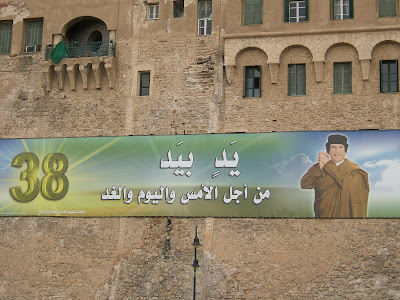
The road to Tripoli, which loomed from the arid ground like a sun bleached skeleton, was regularly punctuated with Gaddafi’s image, either cheery with arms outstretched like an advert for a hotel or sternly looking skyward, wearing a pair of aviator sunglasses like a Top Gun pilot. In both cases it was all rather disarmed by the government issue clip art backdrops.


From the ground level Tripoli could be Whitechapel. It had a similar level of uncleanliness and similarly dressed people selling similar things but with the addition of white gloved traffic police and far more bloodthirsty driving.

We met Mohammed’s boss, Mahmood in our flash hotel. It had the same air of grandeur about it as the Roman City with none of the class. The crumbling teeth in Mahmood’s fixed grin did not detract from his snake eyes.. We spent quite some time faffing around with him and his boss Sami, trying to get what we paid for (all accommodation food and travel) as they attempted to give us less with more an more preposterous excuses.

There was a strong sense of the ‘gilded cage’ very reminiscent of that described in Hergé’s Land of Black Gold in which an almost identical situation is described, Tripoli is our San Theodore and Gaddafi our Colonel Sponsz. We are similarly unable to leave the hotel or eat what we want or drink what we want or talk to who we want. We are getting the full socialist dictatorship experience as described in a text written over half a century ago, at the height of the Cold War.


17/01/08
We visited a city with the same empty sense as the one the humans return to in Planet of the Apes, named Leptis Magna, a 7th century city and the crown of Rome's African empire, under the leadership of Septimus Severus.
Its central point a senate / market and a walled area as big as a football pitch and strewn with headless and castrated statues and broken columns. The whole place was almost empty. It is perhaps a trite point to make but a decadent society consumed by its own greed did ring certain pertinent bells.


We spent the night in the eerie town of Sirt which was under siege from a motorcade of excitable wedding revelers hooting their horns and setting off fireworks we at first assumed to be firearms. People were evidently having fun in this country and we were not getting any of it. Our meal times with Mohammed and his neighbor were becoming filled with more and more awkward silences partly due to the language barrier and partly due to failed attempts to ask probing questions about the country’s regime and possible dissent. The closest we heard to acknowledgment of dissent was rather convoluted. We noticed the neighbor's car has displaying a Brazilian football air freshener from its rear view mirror and yes, it turned out that the neighbor enjoyed watching football on the TV. But, in Gaddafi’s Green Book- The Answer to the Problem of Democracy (his answer to Mao’s little red book, and our answer to long car journeys) it states that, ‘sporting clubs… are rapacious social instruments, not unlike the dictatorial political instruments which monopolize power’, to which Mohammed conceded that these days Libya is more modern than it once was.


18/01/08
The days became a saga –the food was repetitive and plain and eaten in specially designated, empty tourist restaurants.
We do not speak to anyone other the Mohammed who’s English is worse than our French and we are having to endure the driver’s same six CDs, although one of them is a by the Berber musicians, N’Tayaden, which is a ray of light. We are forever being stopped at checkpoints where Mohammed handed over one of his stack of copies of our details in Arabic. What on earth was being done with all this information? Was it going into some vast filing cabinet in one of the mysterious buildings we have passed?

The drive from Sirt to Bengazi was over by early afternoon. The landscape had been quite monotonous; flat arid land and a covering of rubbish that lay for fifteen metres either side of the road. After a great deal of cajoling Mohammed let us leave the hotel we were stationed in by ourselves. We walked down what was to all intents and purposes an Eastern Block sea front replete with mandatory crumbling concrete, but it lacked the grand communal areas. We made our way to the naval base in order to take pictures of the boats to spite the Orwellian ‘administration’.

On the drive we had tried to find out more information about The Great Man Made River. A giant pipe running from the interior of the country to provide water to vast dry arid reasons. Quite how big the environmental impact of this quick fix solution will be is unclear but if it's to be believed, Gadaffi's son has a big job to make this country green.


19/01/08
We visited Cyrene on the way to the border and as uncultured as it sounds, unlabelled Roman remains described by a man clearly making it up as he went and saying it in a made-up language, started to loose some of its original charm.
Apollo’s fountain was striking as it trickled out of the mountain into a jet black, man made pool and through the city in irrigation channels. Also the vista out across the miles of flat land out to the sea was spectacular. Mohammed told us ‘UNESCO will make him nice’ some time in the future.

The drive did provide one surprising aspect a sudden change to a Mediterranean climate with all around being green and dramatic and cavernous gorges which provide a welcome break from the flat arid landscape of the past few days.

During the evening in the hotel with a red interiors the Egyptian proprietor overheard our conversation and said to us privately, ‘you will like Egypt, there are plenty of women and you can have beer. It is not Guantanamo’.


20/01/08
We were driven to the border and eventually allowed to leave Libya. On the Egyptian side we very easily bought visas and passed through into a whole new country and mindset.
As we walked through no man’s land the people behind the fence were very keen to practice their English on us and smiles on peoples face was quite different to the reserved nature of the Libyans, it was good to have some interaction. We took the relatively plush bus four hours to Marsa Mutrah and over-nighted in a pound a night hostel run by lonely looking man and his knot-backed father. It was an all time low on the cleanliness front but it had a certain Parisian struggling artist's charm to it. Egypt immediately seemed to have a greater deal of poverty than Libya but a good infrastructure, and certainly a more welcoming people.

Travel Log 2 - Djerba to Ben Guerdane, Tunisia

13/01/08 – 15/01/08
We spent the first morning in Djerba pacing the tourist beach which in the gloom, swarmed with agéd German tourists with ruddy faces in tracksuits walking as silent couples being smarmed by two greased-back-hair Tunisians on horseback. When unsuccessful in luring a punter into paying for a ride along the beach, they were placated by their in-on-the-scam horses that bit playfully at the shoulders of their handlers. We left the beach passing through the huge construction sites of holiday complexes comprising of bizarre concrete monstrosities patrolled by men in army boots. It was easy to see why this huge development has put such a strain on the islands water resources, the trouble is all there was to the island was the tourist industry.

One of the island's lesser advertised and more interesting ports of call was the mysterious El Ghriba synagogue, apparently home to the world's oldest Torah. The Jewish population was shaken in 2002 during a terrorist attack causing many people to leave the island and it therefore required strict security checks to gain entry. Inside in a corner of the building men with small very similar features on their large faces were absorbed in prayer led by the man with a long wispy beard and wizened features. The building's interior was a visual overload of intricate silver and colored glass. Upon leaving in the taxi we were struck by a moment the likes of which are only indelibly etched upon the memory when there is a serendipitous hand at play – the sound of children laughing in the school, melodramatic 70's French pop on the taxi's radio, the sea blue of the Jewish quarters, the stark white of the synagogue and the yellow of the flowers in the meadow surrounding it.

The vast Monday night market back in town was an impressive sight. Tables heaved with piles of second hand clothes and dates and pick up trucks displayed their cargoes of oranges. Spice stalls filled the air with reminisces of foods from all over the world. On our way to get a bite to eat we were got talking to a pair of likely lads named Omar and Rauph, who fitted the mold of Del Boy and Rodney snuggly. One had a Polish wife and the other a degree in sociology and they were in the process of setting a business selling camel tooth jewelry. It was hard not to be wary of them with their complex haircuts and fake Ray Bans, but we shared sweet, smoky, grainy black coffee with them, invariably in brightly lit cafes with smartly dressed, smoking waiters and raucous card games all about. We really need not have worried, but it’s a mentality that is the curse of the guide book.

Leaving Djerba we took a cramped louage (minibus) to Ben Guerdane – the last town before Libya, and over-nighted in a clammy little hotel with a mischievous proprietor who pulled faces behind the police while they checked our passports.

It was a cowboy town of unpaved street, stinking sewers and immaculately turned out Libyans strolling about the place posturing widely in fake designer wear and in flashy cars, while many of the townsfolk scooted about on horse drawn carts. While one street was entirely dedicated to small huts containing an oversized calculator, bed, TV and drawer of money for exchanging Tunisian Dinars for Libyan.

Monday, 14 January 2008

Travel Log 1 London to Djerba, Tunisia

09/01/08
With an overbearing sense of bewilderment we began our journey proper from London. Other than the hour lunch in Paris we headed straight for the ultra efficient TGV to Marseille. The Eurostar afforded us enough time not to complete the day’s crossword. As we crossed France looking out as the countryside gradually change from the train’s second deck we were left thinking, the French know how to organise their public transport.


10/01/08
Marseille seemed to be a city of lax planning regulations. Austere colonial architecture was interjected by Fraco-esque high rise modern living. The dark take on modern living continued into the city’s bowels where the metro seemed to be in a state of 1970’s stasis with everything in a shade of orange which assumed the city’s citizens would be taking public transport to Mars by now. This however is not a fair reflection on some of the beautiful buildings and churches we passed by, it just difficult to appreciate them in the January gloom that smacked of Blackpool.

The hour delay for the ferry to Tunis was the first taster of the waiting game we are sure we will have to play again and again with forty or so foot passengers for company, most of who appeared to be shopkeepers with huge loads of goods. It was a good opportunity to pick up some clues on how Tunisians operate because we were unlikely to pick much up with our broken French and a complete lack of Arabic (thus far). There did not seem to be a rule as to the number of kisses they gave each other on the cheeks. The question that arose was, how do they avoid the embarrassment of leaning in for a kiss that the other party is not willing to reciprocate? Their personal space seemed even smaller than that of the French and their gesticulations all the more categorical, with an emphasis upon an out stretched arm with all fingers brought together as if plucking a grape from a vine. As they talked it seemed as if from sentence to sentence the flipped from telling one another their house was going to be repossessed, to them letting them know that they would be marrying into the other party’s family with their own fortune.

It will be intriguing to see these minutiae in cultures change as the landscape does as we travel towards South Africa.

There must have been five hundred berths onboard the ferry, most of which were empty and seemed to be in a state of being cleaned for the entire journey. There was a definite sense of colonial era travel, with the waiter service and entertainment, but the long curving staircase to the bar with a dance floor had a filthy carpet more reminiscent of the Dover to Calais experience. That night we were treated to a set of what were evidently Tunisian classics, by the reactions of the tipsy gentlemen pulling shapes such as the ’measure the arm length at the tailors’ and the ’wafting of a burn on the forehead with outstretched arms’ on the dance floor. The sleep we got that night was un-funnily hysterical. The ship’s syncopated judder felt like the sofa upon which another person is sitting and who is finding something inappropriate hysterical and remains on the brink of guffaw. As this reverberated through us as we slept on the floor of the ’quiet’ lounge a group of shopkeepers entered and conducted some kind of anarchic tea party at top volume. It became clear we were already a long way from home.

11/01/08
We awoke to the sound of Hoovers and the sun rising over the Northern tip Africa.
It was upon arrival at passport control that we were definitely not yet in the zone because we had not filled in the appropriate pass cards while onboard. After sorting out the issue we declined the offers of the cawing taxi drivers intent on taking us into Central Tunis and walked off to try and find the train station. This was the first instance of troublesome public transport not being the easy option. The train took us to the centre of Tunis where we walked to the medina to find our accommodation for the night. The Medina was a set of high, narrow streets filled with Chinese plastic from different moulds to those were accustomed to, the intrigue of which was lost, as there was a overriding sense of being perpetually swindled by people bumping into us and just so happening to the location of King Ottoman’s wife’s bed above a rug shop and so on. One Fagin / Oddjob character we allowed to boss us around for a while, telling us to take pictures of seemingly random objects who we managed to placate, unsurprisingly, with money, put it well when he said ‘Tourist love Tunis, Tunis love tourist’. He also said ‘You not catch plane? You not capitalist!’, which was even better.


Being engulfed in Islamic architecture and interiors has left me feeling that I am missing out on something. I am sure that there is something to see in the intricate repetitions of patterns on tiles and in the symmetry of the domes and pillar alignment that I cannot see.

What I can see in this environment is something far more repetitious - a regurgitated aesthetic ideal marketed at individuals such as myself, the model of which I have seen countless images customised to. It is the image with the pretence of being un-sanitised and authentic. It is the perfectly ‘antiqued’ archway framing a poor child in ‘distressed’ clothing playing with a ‘crossbreed’ cat on a ‘traditional’ road I saw today and wished I had my camera with me.

A concerted effort is going to be required to accommodate other culture’s take upon beauty and not have my field of vision narrowed down by search for it improbable places. Stuart does not entirely agree with this, hence it being in the first person.

12/01/08
One of our Australian dorm mates found the throwing of shoes at the snoring Stuart even more amusing than Toby. An early rise and off to see the Grand Mosque which was both peaceful and grand at once, which is quite an achievement.


We planned to reach Djerba today, an island in the South of Tunisia popular with package holidays that while benefiting the island’s economy, are apparently severely affecting the island’s water supply. To get to Djerba we were going to get the train to Sfax, Tunisia's second city. On the way to the station we happened upon an impressive market behind an unassuming entrance way. There were bull heads in buckets, mountains and olives and fruits and a cheeky lady who let us try some different cheeses. After a wander round we were well stocked for the travel ahead.


From Sfax we caught the Louage (minibus) to Djerba. The Louage ‘station’ was fairly chaotic with bus drivers attempting to fill there bus in order for them to travel economically. The bus journey was an interesting experience in its own right. We shot down arrow straight roads cutting through the olive groves, weaving through the traffic. Stopping abruptly for yet more coffee and cigarettes then shooting off again. During the night, we passed eerie restaurants illuminated by fluorescent bulbs of various garish colours hung from the beams of their outdoor seating areas. Men ate below the carcass of an eviscerated sheep with its fleece still upon its back, which dangled from a chain on the ceiling. This scene was repeated in restaurant after restaurant in what seemed like installation art.

The man running the Youth Hostel in the islands capital was an amazing character with full Tunisian garb, shin length hooded fleece top with tassels and Yassar Arafat style head scarf and requisite dusty laminate shoes and no socks. We are pretty sure when he was younger he was a fearsome character. That night we ate like kings on roadside tuna and almost raw egg pizza followed by shish and coffee.

The next few days are to be getting an idea of Djerba before heading for the Libyan border and Allah willing we will have visas given to us on the border by the tour company you are required to have.
Until we work out how to get all the photos on the blog you can see them at;